How I Built a Birth Chart Calculator From Real Planet Data
Behind the birth chart tool on Memento Astra: the maths, the 3D sky, and the parts that surprised me.
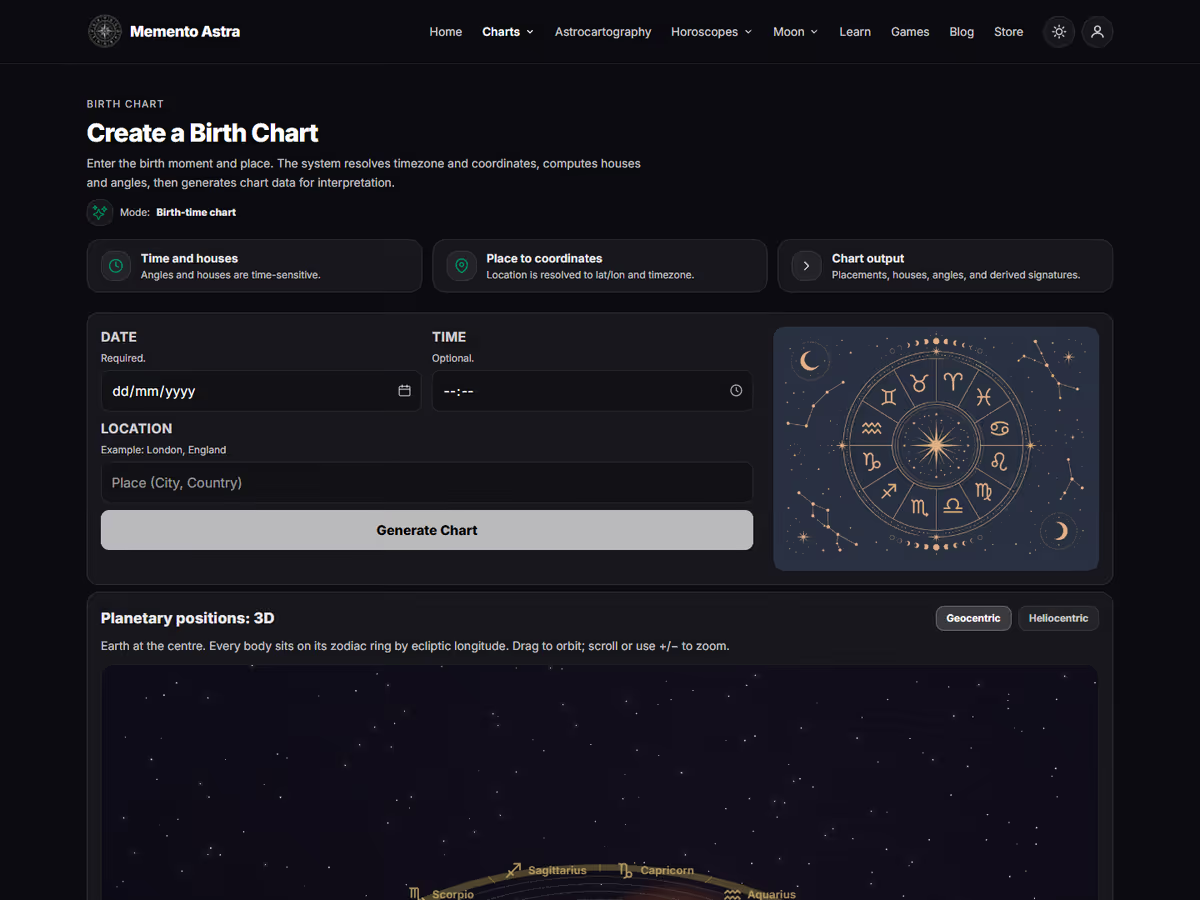
A birth chart is a snapshot of the sky at the exact moment you were born, seen from the exact place you were born. Where the Sun was, where the Moon was, which planets were rising over the horizon. When I started building Memento Astra I made one rule for myself: every chart would be calculated from real astronomical data for that moment and that place, never looked up from a table of star signs.
That rule turned a simple looking form into one of the most interesting things I have built. Here is what happens between you typing in your birthday and the chart appearing.
Three things go in
The form asks for three things: the date you were born, the time if you know it, and the place. Each one does more work than it looks like it should.
Turning a place into a moment First the place. You type something like "London, England" and the server turns it into map coordinates. Those coordinates then decide the timezone, and the clock time you were born is converted into universal time using the timezone rules for that date, so summer time and old clock changes are taken into account. Get this step wrong and the whole chart shifts, which is why it happens before any astrology at all.
Where the planets actually were With a precise moment and a precise position, the calculation can start. The positions come from the Swiss Ephemeris, the same astronomical data that serious astrology software is built on. I run a WebAssembly build of it on the server, so it works inside the same JavaScript stack as the rest of the site, and it gives every planet's position to a fraction of a degree, along with its speed and whether it is retrograde.
Some of it moves surprisingly fast. The Moon covers around thirteen degrees of sky a day, so a few hours can change your Moon sign. The Ascendant, the sign rising on the eastern horizon, turns through the whole zodiac every day, roughly one sign every two hours. That is why the time box matters so much: the date gives you your planets, but the time gives you your angles and houses.
The fun part: actually seeing it
A list of degrees is accurate, but it is not much fun to look at. So the results come in layers. There is a 3D view of the sky that you can drag and spin, with a switch between an Earth-centred view (how astrology sees it) and a Sun-centred one (how the solar system really works). There is an animated diagram of the planets, and the classic round chart wheel, where tapping a planet shows you every aspect it makes.
Underneath that sit the details astrology fans go looking for: Chiron, Lilith, the four main asteroids, the Part of Fortune (whose formula flips for people born at night), the Vertex, contacts with 42 fixed stars, the overall shape of the chart and any named patterns in it. Each one is calculated, not decorated.
Keep it, share it, print it You can download your chart as an image, share a link that rebuilds the same chart for whoever opens it, or print it and save it as a PDF. It is free to use and you do not need an account to cast a chart. If you want to keep a list of the charts you have made, you can sign in and save them.
Famous charts as worked examples. One of my favourite parts of the site is the collection of celebrity charts: 13,000 notable people, with their birth details taken from Wikidata and a note on how reliable each birth time is. They are the best way to see what a finished chart looks like before you make your own. Frida Kahlo, for example, was born with the Sun in Cancer and the Moon in Gemini. You can browse them all in the celebrity birth chart collection.
What I took away from it The hardest part was not the astronomy, it was everything around it: getting places and timezones right for people born decades ago, keeping a 3D scene smooth on a phone, and presenting a lot of information without burying the person who just wants to know their rising sign. It is the kind of problem I love, because the details are where it either feels trustworthy or it does not.
If you know your date, time and place of birth, you can cast your own birth chart on Memento Astra in a few seconds. And if you are curious how the whole site was put together, the Memento Astra case study in our portfolio goes into the build.